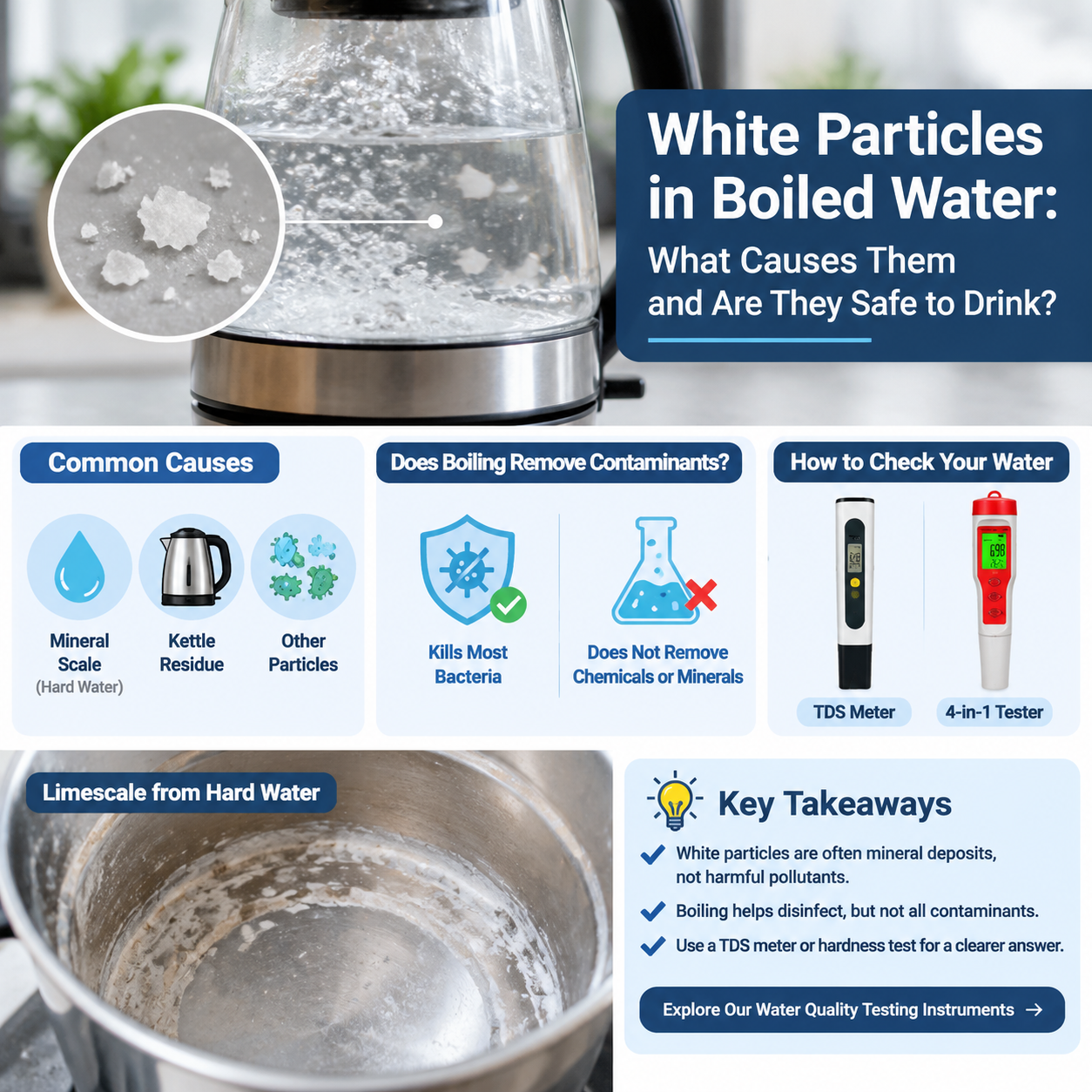
Have you ever noticed tiny white flakes floating in your kettle or drinking glass after boiling tap water? You are not alone. Many people notice white particles, cloudy water, or chalky deposits after boiling water and wonder whether something is wrong with their drinking water.
Some people assume these particles are harmless minerals. Others worry that they could indicate contamination, bacteria, or residue from the kettle itself.
So, what are these white particles actually made of? Does boiling water make them appear? And how can you determine whether your water needs further testing?
In many cases, the explanation is related to water hardness. However, not every white particle has the same cause. Understanding the possible sources is the first step toward making an informed decision about your drinking water.
Quick Answer
White particles in boiled water are often caused by mineral deposits, especially calcium carbonate formed when hard water is heated. Ordinary mineral scale is generally not considered harmful at typical drinking-water concentrations. However, appearance alone cannot confirm water safety. A dedicated hardness test or appropriate water-quality analysis can help identify the cause.
1. Why Are There White Particles in Boiled Water?
One of the most common explanations is mineral precipitation caused by heating.
Tap water naturally contains dissolved minerals. In areas with hard water, calcium and magnesium are present at relatively higher concentrations.
These minerals are not necessarily signs of pollution. They are naturally occurring components of groundwater and other water sources.
How Does Boiling Create White Particles?
The process is related to temporary water hardness.
Groundwater can contain dissolved calcium and magnesium bicarbonates. When water is heated, bicarbonates can decompose and form less-soluble mineral compounds.
For example, calcium bicarbonate can form calcium carbonate, which is much less soluble in water. The calcium carbonate may then appear as:
- White flakes floating on the water surface.
- Fine white particles suspended in the water.
- Chalky deposits at the bottom of a kettle.
- White scale attached to the heating element or kettle walls.
This is commonly known as limescale. The deposits may become more noticeable after repeated boiling because minerals gradually accumulate inside the kettle.
Are These White Mineral Deposits Harmful?
Not necessarily. Calcium and magnesium are common minerals in drinking water, and ordinary limescale is generally not considered a health hazard at typical drinking-water concentrations.
However, appearance alone cannot confirm the identity of the particles or establish that the water is safe to drink.
2. Is It Calcium Scale or Something Else?
White particles are often associated with hard water, but it is important not to assume that every white particle is calcium carbonate.
Three Possible Sources of White Particles
A. Mineral Deposits from Hard Water
This is a common explanation when white scale gradually builds up inside the kettle, similar deposits appear after repeated boiling, and the particles look chalky or powdery.
B. Residue from the Kettle or Water Equipment
Particles may come from mineral scale that has detached from the kettle walls, deteriorated seals or internal components, or filter media escaping from a damaged or improperly installed filter cartridge.
C. Other Suspended Materials
Particles that are unusual in color, accompanied by an unexpected odor, or associated with sudden changes in water appearance deserve further investigation.
If particles appear suddenly after replacing a filter or changing equipment, inspect the relevant components.
Collect a sample in a clean, transparent glass and observe whether the particles settle, remain suspended, or appear again after boiling a fresh sample. This is a useful observation, but it is not a laboratory identification test.
3. Does Boiling Water Remove Contaminants?
This is one of the most important distinctions in drinking-water safety.
Boiling is an effective method of disinfecting water. It can inactivate many disease-causing microorganisms, including bacteria, viruses, and parasites, when performed correctly.
However, boiling is not a universal water purification method.
What Boiling Can Do
Heat can inactivate many harmful microorganisms when water is boiled correctly.
What Boiling Cannot Do
Boiling does not reliably remove dissolved minerals, heavy metals, salts, nitrates, or many chemical contaminants.
Why Can Some Contaminants Become More Concentrated?
As some water evaporates during prolonged boiling, non-volatile dissolved substances can become more concentrated in the remaining water.
This explains why boiling water and testing water quality are two different processes.
Boiling helps control microbiological risks. It does not prove that water is chemically safe.
For emergency disinfection, public health agencies commonly recommend bringing water to a rolling boil for one minute, or three minutes at elevations above 6,500 feet. Always follow local public health instructions when a boil-water advisory is issued.
4. How Can You Check Whether Your Water Is Hard?
If you suspect that white particles are caused by mineral deposits, water hardness is a useful parameter to investigate.
Water hardness mainly refers to the concentration of dissolved calcium and magnesium ions. There are several ways to assess it.
Method 1: Use a Water Hardness Test Kit
A dedicated water hardness test kit can help determine the hardness level of a water sample.
Depending on the test method, results may be expressed as mg/L of calcium carbonate (CaCO₃), mmol/L, or other hardness units.
This is a more direct approach than using a general TDS meter when your specific question concerns calcium and magnesium hardness.
Method 2: Use a TDS Meter for a Quick Screening Measurement
A TDS meter measures the estimated total dissolved solids in water, commonly displayed in ppm or mg/L. Most handheld TDS meters estimate this value based on electrical conductivity rather than identifying individual substances.
It is useful for comparing water samples and observing changes in dissolved-solids levels.
For example, you can compare:
- Tap water before filtration.
- Filtered water.
- Water from different sources.
- Water before and after a change in filter cartridge.
However, a TDS meter does not identify individual minerals. A higher TDS reading does not automatically mean that water is unsafe, and a lower reading does not guarantee that it is free from harmful contaminants.
If you want to know specifically whether calcium and magnesium are responsible for white scale, use a dedicated water hardness test.
5. How to Use a TDS Meter to Check Drinking Water
A handheld TDS meter is a convenient tool for routine water-quality comparisons. The general measurement procedure is straightforward.
Prepare a Sample
Collect water in a clean glass or container.
Rinse the Probe
Rinse the sensing area according to the manufacturer’s instructions.
Take a Reading
Immerse the sensing end to the indicated level.
Wait for Stability
Allow the displayed value to stabilize before recording.
Compare Samples
Compare tap water and filtered water under similar conditions.
For reliable comparisons, use the same meter, clean containers, and consistent measurement procedures.
A TDS meter is especially useful for monitoring changes over time, but it should not replace laboratory testing when specific contaminants need to be identified.
6. What Should You Do If White Particles Keep Appearing?
The next step depends on what you observe.
| What You Notice | What to Investigate |
|---|---|
| White chalky deposits inside the kettle | Water hardness and mineral scale |
| White particles appearing after repeated boiling | Mineral precipitation and kettle maintenance |
| Particles appearing after a filter replacement | Filter installation and possible media leakage |
| Sudden cloudy or discolored tap water | Plumbing, supply conditions, or local water-quality notices |
| Unusual odor or persistent changes in appearance | Further water-quality investigation |
If the water suddenly becomes cloudy, discolored, or develops an unusual smell, do not assume it is harmless mineral scale. Contact your water supplier or local public health authority for advice.
If you need to establish whether the water meets drinking-water standards, use an appropriate certified laboratory or an approved testing service.
7. Choosing the Right Water Testing Instrument
Different water-testing instruments measure different parameters. Choosing the right tool depends on the question you want to answer.
TDS Meter
A TDS meter is suitable for checking estimated total dissolved solids and comparing water samples.
- Comparing tap water and filtered water.
- Monitoring changes in water after filtration.
- Checking general dissolved-solids levels.
pH Meter
A pH meter measures the acidity or alkalinity of water. It is useful when you need to monitor pH changes in drinking water, household water systems, or other water applications.
Multi-Parameter Water Tester
A multi-parameter water tester combines several measurement functions in one handheld instrument.
Depending on the model, it may measure parameters such as pH, TDS, electrical conductivity (EC), or temperature. Always check the specifications of the individual instrument before selecting it.
Water Hardness Test
If your main concern is calcium and magnesium deposits, choose a dedicated water hardness testing method rather than relying on a TDS reading alone.
Explore Water Quality Testing Instruments
Looking for a convenient instrument to compare water samples and monitor common water-quality parameters? Explore our range of handheld water-testing devices and choose a model based on your measurement requirements.
VIEW TESTING INSTRUMENTS →Frequently Asked Questions
Are White Particles in Boiled Water Harmful?
In many cases, white particles are mineral deposits, commonly associated with calcium carbonate formed during heating. Ordinary mineral scale is generally not considered harmful at typical drinking-water concentrations. However, appearance alone cannot confirm the composition or safety of a water sample.
Why Does My Kettle Have White Flakes Even When I Use Tap Water?
Tap water naturally contains dissolved minerals. When water is heated, some calcium and magnesium compounds can form less-soluble deposits. These deposits may accumulate on the kettle surface or become suspended in the water.
Does Boiling Water Reduce TDS?
Not necessarily. Boiling does not remove most dissolved minerals. If water evaporates, the concentration of non-volatile dissolved solids in the remaining water may increase.
Can a TDS Meter Detect Calcium in Water?
A standard TDS meter estimates the total concentration of dissolved solids. It cannot identify calcium separately or determine the exact calcium concentration. A dedicated water hardness test is more appropriate for assessing calcium and magnesium hardness.
Does Low TDS Mean Drinking Water Is Safe?
No. TDS is only one general water-quality indicator. Some harmful substances can be present at concentrations that do not significantly change the TDS reading. Drinking-water safety requires testing for the relevant parameters.
What Is the Difference Between TDS and Water Hardness?
TDS represents the total estimated dissolved solids in water. Water hardness mainly refers to dissolved calcium and magnesium ions. Hardness contributes to TDS, but the two measurements are not interchangeable.
Final Thoughts
White particles in boiled water are often related to mineral deposits formed when hard water is heated. In many ordinary household situations, these deposits are primarily a matter of water hardness rather than an immediate health concern.
However, not all visible particles have the same origin, and clear-looking water is not necessarily safe water.
The most practical approach is to identify what you want to measure first.
If you want to compare dissolved-solids levels in tap water and filtered water, a handheld TDS meter is a convenient starting point. If you want to investigate white mineral scale, use a dedicated water hardness test.
Understanding what each instrument can and cannot measure helps you make more informed decisions about your water.
Make Better-Informed Water Testing Decisions
Explore LIVEX water quality testing instruments and find a suitable tool for your measurement needs.
EXPLORE OUR INSTRUMENTS →